The Dead Fern on Your Desk Is Trying to Tell You Something
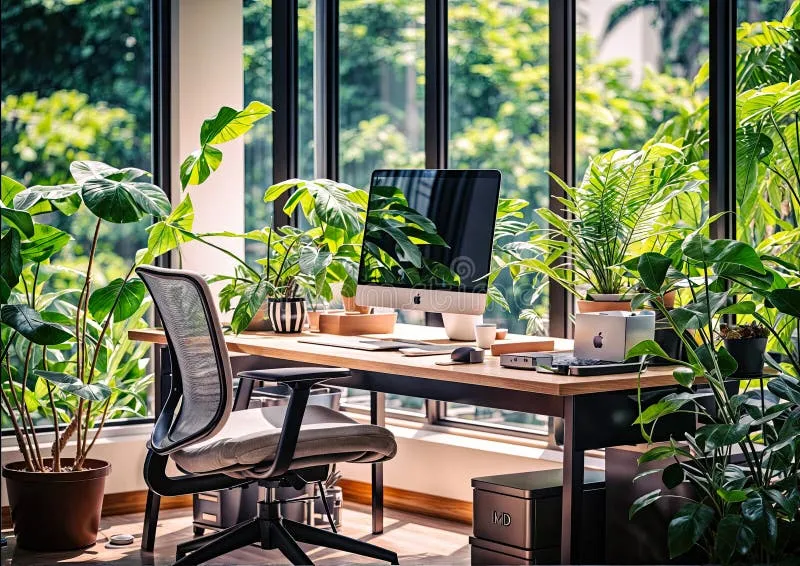
Photo: wilting office desk plant on workspace next to computer, via thumbs.dreamstime.com
Somewhere in an office park in Ohio — or a spare bedroom in suburban Dallas, or a corner cubicle in a Seattle high-rise — there's a fern that hasn't been watered in three weeks. Its owner is a competent professional. They hit their deadlines. They answer emails promptly. But that fern? It's a goner.
Here's the thing about that fern: it's not really about the fern.
Workplace psychologists have long noted that the environments we build around ourselves function as a kind of passive diary. We don't set out to communicate anything when we stop replacing the burnt-out bulb in our desk lamp or let a once-thriving pothos shrivel into a brown nest. But these small acts of neglect tend to track something bigger: how much energy we have left over after the job takes its cut.
Your Desk Is a Diagnostic
Think of your workspace as a check-engine light. Nobody's judging the aesthetics — some of the best work in American business history happened on cluttered desks in garages in Palo Alto and Detroit. The question isn't whether your space looks like an Instagram home office. The question is whether the way you treat it reflects someone who plans to stick around.
The pattern usually shows up in a few telltale zones:
Greenery. Living things on your desk require maintenance, and maintenance requires a belief in a future. When someone stops watering the plant they bought specifically to make their space feel more human, it's rarely forgetfulness. It's often the first visible symptom of a person running on fumes.
Lighting. Fluorescent hum, a monitor glare situation you've complained about for two years, a desk lamp you keep meaning to replace. Light affects mood and focus directly — which is why tolerating bad lighting for months is less about laziness and more about having quietly stopped believing the environment is worth improving.
The chair you never adjusted. Ergonomics is the ultimate act of optimism. Raising your monitor, adding a footrest, fixing your posture — these are investments in a body that will be sitting there next year. If your setup has looked like a temporary arrangement for eighteen months, your subconscious may be treating your job as temporary, too.
The stack of unread papers. Piles aren't inherently bad. But there's a difference between active clutter — projects in motion — and sediment, the kind that accumulates when dealing with things feels pointless. Sediment is what happens when your to-do list and your motivation stop speaking to each other.
The 10-Point Workspace Checkup
Grab a coffee and take an honest lap around your own setup. Score yourself one point for each "yes":
- Is there at least one living thing (plant, herb, even a lucky bamboo stalk) that you've kept alive for over three months?
- Have you adjusted your lighting in the past year — added a lamp, swapped a bulb, repositioned your monitor to kill glare?
- Would your chair pass a five-second ergonomic sanity check (feet flat, screen at eye level, lower back supported)?
- Is your current clutter "active" — in-progress work — rather than a layer of things you've stopped looking at?
- Have you personalized your space at all in the last six months (a photo, a print, a mug that isn't from a conference swag bag)?
- Do you know where everything important is within arm's reach?
- Have you fixed — or at least submitted a ticket about — something broken in your environment this quarter?
- Does your space have anything in it that exists purely for your own enjoyment, not productivity?
- Would you be mildly annoyed if a facilities person "cleaned up" and moved everything, because the arrangement is actually yours?
- Can you picture yourself at this desk, roughly as configured, a year from now without flinching?
Score 7 or higher: your space is telling a story of someone with reserves — someone who sees a future here. Below 4? That's not a decorating problem. That's a data point about your relationship with your work, and it deserves a closer look.
Small Fixes, Real Signals
Here's the good news: the feedback loop runs both directions. Environment shapes behavior just as much as behavior shapes environment. You don't need a $2,000 standing desk or a fiddle-leaf fig with a personality. You need a handful of deliberate, cheap moves:
Adopt a plant with a forgiving personality. Snake plants and pothos are famously hard to kill, which makes them perfect for rebuilding the watering habit without setting yourself up for another tiny failure. The act of care matters more than the horticulture.
Spend $15 on light. A warm-toned desk lamp changes the entire emotional temperature of a workspace, especially during gray winters in the Midwest or Northeast. It's the highest-return decoration money can buy.
Do a ten-minute sediment sweep. Not a full reorganization — just remove the layer of stuff you've stopped seeing. Shred the papers from a project that closed in March. Toss the dead pens. You're not tidying; you're clearing visual noise your brain has been paying rent on.
Claim one object that's purely yours. A photo from a good trip. A print from a small artist. Something with zero professional utility that makes the space feel inhabited rather than assigned.
Fix one broken thing this week. The wobbly monitor arm. The drawer that sticks. Submit the ticket, grab the screwdriver, make the call. Follow-through on small repairs is a surprisingly reliable proxy for follow-through in general.
When the Diagnosis Runs Deeper
A word of honesty: sometimes a dead plant is just a dead plant, and sometimes a sad workspace is a symptom of something a pothos can't cure. If your scores are low across the board and the thought of fixing any of it feels exhausting rather than motivating, that's worth paying attention to. Workspace neglect can be the visible tip of burnout — and burnout responds to rest, boundaries, and honest conversations with your manager or a professional, not to desk accessories.
But if you're simply in a drift — that gray zone where the job is fine and the days blur — your desk is a good place to start the conversation with yourself. Tend to the space, and notice what shifts. Often the plant comes back to life right around the time you do.